The sole aim of SEO is to create content that aligns with search intent. While SEO is a way to get more traffic to your website, this aim can only be achieved when you attract more people to your site, which could lead to more sales and returning visitors, and your website can be ranked high on Google.
This may sound easy. However, to get people to your site, you need to optimize your content for the right keywords.
Search intent becomes a factor since it increases your chances of ranking, convincing people to buy your stuff, subscribing to your newsletter, or even coming back to your website.
This article will give you a complete overview of search intent, breaking down its types, importance, and how to optimize your content to meet user expectations. Ready to unlock the potential of search intent? Let’s dive right in!
What is search intent?
Many people perceive search intent differently. It can also be referred to as keyword intent, while other people see it as audience or user. However, the overall aim is to satisfy the purpose of a user’s search.
Search intent has gained prominence since Google incorporated natural language processing and machine learning into its search algorithms through the Hummingbird update and the RankBrain algorithm.
Understanding search intent can help you create effective content that targets potential customers.
#2. Why search intent is important to SEO
Understanding search intent offers you a chance to rank and to see whether your audience is satisfied with your content.
Google’s overall aim is to provide readers with the most relevant result for their query, which is why it also emphasizes intent in its quality evaluator guidelines.
Here are a few tips to help you understand search intent and, when implemented, improve your content.
- Focus more on effective keyword research by targeting search terms that align with your business and your audience’s needs.
- Your content should answer user questions and structure pages to be both user- and search engine-friendly.
- Create content that search engines will appreciate and that is more valuable and relevant to their users.
These factors drive your success on Google as a business, and when you organize your content and make it universally accessible and useful, you are good to go.
What are the 4 Types of Search Intent?
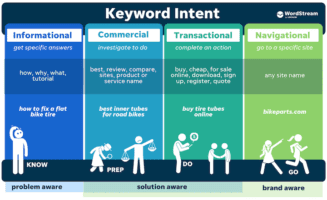
The following are the four types of search intent:
Informational
The intent here is to learn something. It is a situation where users might want to solve a specific problem or answer a specific question. However, searches with this intent use words like how to, what is, where is, or many times it could be just a topic (head keywords).
These questions listed here that are often asked range from specific to complex. For more specific queries with real answers, Google often uses SERP features to answer the question in order to avoid users leaving the page.
It’s relevant to your business
Largely, searches performed on Google arise from informational queries. They are indeed valuable tools for growing your business, since every website wants visibility.
Remember, when you provide your audience with informational or educational content, it builds trust in your expertise and also increases your visibility. You can use this content to target new leads, which in turn can be converted later.
Optimize for informational intent
For optimal informational intent, pay attention to the information users are searching for and ensure what your content provides meets users’ intent.
Navigational
Navigational intent is simply a process by which the user wants to find a specific page. It could be a domain or physical address. It overlaps with Google’s “visit” and “website” user intents and includes local search.
The basis of navigational intent is its quick approach, where users already know what they’re trying to find. If your target is such a keyword, you don’t need to sell them on something new.
Trust me, Google’s mission is to deliver it to you in the most effective and efficient manner you can imagine. Google uses SERP features like knowledge panels or local packs in order to achieve this result.
The knowledge panel provides more context, including a link to Google Maps and a phone number. For a search phrase, make sure your local listings are correct and up-to-date. Additionally, ensure your location and contact information are easily accessible on your website.
It’s relevant to your business
The whole idea of navigational keywords is to ensure either current or future customers can easily locate you when they need you. Don’t forget, they’re branded and, as such, can offer insight into how users interact with or think about your brand.
How to optimize for navigational intent?
Site structure organization is key, and when it is well structured, it becomes easy to navigate to target navigational keywords. That means each section of your site should be clearly labeled, with page titles, tags, headers, and descriptions that tell the user what information they’ll find there.
Don’t forget, your product or service you offer has a dedicated landing page containing all the most relevant information. When you optimize each page by using suitable brand and product names, you are good to go.
Examples of navigational searches:
- “ Beginners’ guide to SEO moz”
- “ahrefs content explorer”
- “Facebook”
- “Twitter login”
Transactional
Transactional intent could also mean commercial intent. The user’s intent is to do something specific using their devices or in person. A user with a transactional search may be willing to complete an email signup, form submission, store visit, or a phone call.
Some transactional queries are direct, thereby making what the user is trying to do obvious.
However, many times it’s not clear whether a user’s intent was transactional, commercial, or informational. This is common when the search term is the name of a specific product. In such a situation, the search results will include various SERP features to help users research that product or complete their purchase.
It’s relevant to your business
Transactional keywords serve as an image for your money makers. These are the keywords your future customers use when they’re ready to convert, whatever conversion means for you.
Graze the opportunity today by targeting transactional keywords with an optimized product landing page and an easy purchasing process.
How to target transactional keywords
Targeting transactional keywords means:
- Knowing what conversion means to you. Whether you want your users to register or buy something.
- Make all relevant information available, and it should be user-friendly.
You can achieve this by making sure all relevant pages are easy to find with the right information so that users can complete the desired action.
More importantly, make sure you’re directing users to a page designed for this purpose, whether it’s a product or a landing page. This page should have:
- Page title, description, and headers that include your keywords and indicate the purpose of your page.
- Have a clear CTA that can easily be identified and understood by users.
- Your design should be able to offer users the information they are looking for as quickly as possible so that the conversion process can be easily completed.
- Conversion to optimized text will be simplified.
Commercial search intent
Commercial search intent can best be described as a fusion of informational and transactional. It means users are weighing up several options, which could best be seen as reviews and comparisons.
On the other hand, these are the keywords the audience uses when they’re doing their research before making a purchase decision.
For a commercial search intent of this kind, the SERP feature compares both products so that users can make purchase decisions easily.
It’s relevant to your business
The thrust of commercial keywords is about showing your audience what you have to offer and giving them the information they need to convert. How resourcefully the audience finds and uses this information, trust me, users will make the purchase decision.
With these keywords, you’re staying connected with your user during one of the most important parts of their buyer’s journey.
How to optimize for commercial intent
Just like informational keywords, it is applicable to commercial intent if you want to target commercial keywords. Firstly, you must be able to know what the user is asking for.
Secondly, structure your page so that users can find the answer as efficiently as possible.
You must accept the fact that information is the most prominent and important part of search intent. For instance, if you are dealing with phones, ensure the name of the phone, the rating, and a link to reviews are all displayed on top, followed by the technical specs and other details.
This is the only way users can also expand if they want to learn more about why the editors came to their conclusion and, at the end of it, users can educate themselves and make smooth purchase decisions.
In summary, ask yourself first, what is your audience trying to find on this page? This will enable you to build a well-structured page with that need in mind.
Your next plan is to optimize it with descriptive page titles, headers, meta descriptions, and URLs.
You can make it as easy as possible for them to purchase, with links to more information, lead generation forms, or purchase pages.
#4. How to determine search intent by keywords
Search intent is an important aspect of content creation that can’t be overlooked. Determining search intent means ensuring the intent corresponds with where users are in the marketing funnel.
In achieving this, create awareness of how to do keyword research (Informational keywords), also consider the best keyword research products (commercial keywords), and finally subscribe in order to start enjoying conversions (transactional or navigational keywords).
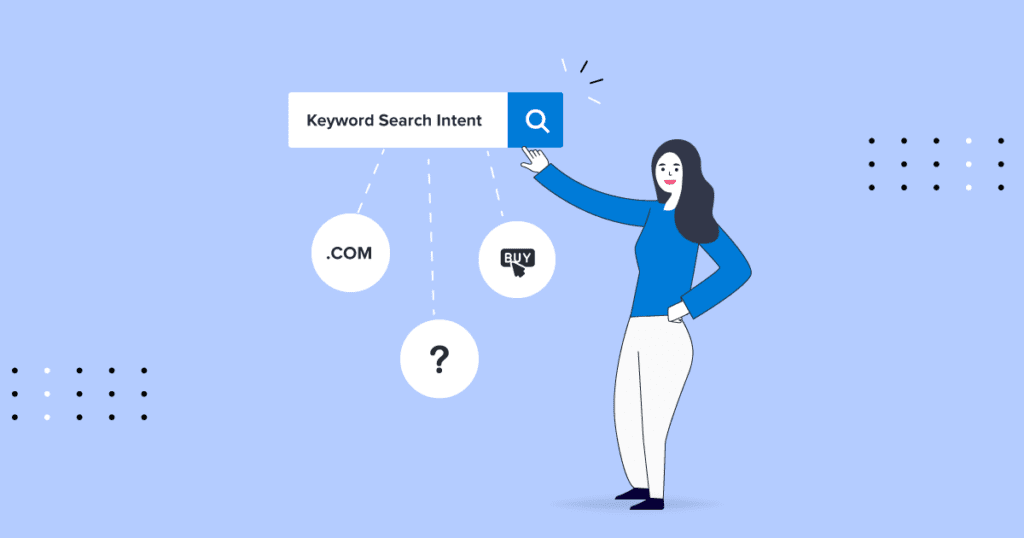
Do you know that, many times, a keyword’s intent can be determined based on the keyword itself and its search results?
Take, for instance, the informational keyword can use question “words” to indicate what the user is learning. The results might include a snippet answering the user’s question.
In the same manner, a commercial transactional keyword may reference a specific product or type of product, and such queries might generate a carousel of products, user reviews, or links to retailers.
With this, don’t bother yourself with identifying; use Semrush to find search intent during your keyword research by using the Keyword Magic tool. You can filter by search intent and target only those that align with your goals:
If you’re researching a single keyword, you can also find this information in Keyword Overview:
You can create a more targeted content strategy to connect with your audience more effectively and rank higher using this knowledge.
SEO Benefits of Intent Targeting
Search intent can’t be separated from semantic SEO, which is why search intent is considered a larger aspect of semantic SEO that ensures relevant search results are delivered to users.
Your website can only record more relevant and qualified traffic with the use of better intent optimization.
Additionally, this could improve conversion rates for your landing pages, with numerous other benefits attached to your content types, such as:
#1. It reduces bounce rates. People are likely to stay on your page because they get what they want.
#2. Increase in page views: When the intent of users is met, this makes them more engaged with the rest of your website.
#3. More featured snippets: Having your content selected for Google’s rich snippets can benefit you in no small measure. It allows your pages to rank in position 0 above the first search result.
#4. Wider audience coverage: Google is always on top of the job. That is to say, Google can interpret multiple queries with the same topic and intent. That means it will show your optimized page for a lot more questions.
Search intent optimization benefits can’t be overemphasized, given its robust benefits. You are encouraged to do it right, and expect a good number of audience, coupled with more qualified traffic, and better engagement metrics for your content.
#5. How to optimize your content for search intent
Satisfying the desire of your audience is what we call search intent optimization. Therefore, you must be able to make sure a landing page befits the search intent of your audience for the information they are looking for.
Your failure to display a product page before them may possibly chase them away. Assuming someone wants to buy your product and lands on one of your lengthy essays, so-called blog posts, you might definitely lose such a buyer. And this is why you have to lead them to your shop and with the right product page.

Therefore, optimizing your product pages for commercial-driven keywords is not a bad thing but a plus on your part.
But remember the best place for you to start optimizing for search intent is your marketing personas. This means the personas should be driving much of your marketing efforts, but don’t forget, their importance is predominantly when it comes to intent optimization.
Therefore, be prepared that your personas should cover areas such as customer goals and tasks to complete, pain points and challenges to overcome, and, lastly, how they use products/services like yours.
In principle, getting to understand the needs of your customer can help you predict their intent behind a particular search. This is where you can then target those people by creating specific content for each persona and each intent.
Conclusion
Content writing revolves around search intent and, as such, your choice of keyword used in the content becomes pertinent.
Your post or page should always be informational so as to guide people who are looking for information. Set a target for yourself so as to get the first result when someone searches for your company name.
Always ensure the content you provide helps people make an informed decision when they’re still investigating their options. Ultimately, lead people to your sales pages if they are looking to buy one of your products.