Digital marketing and PPC move at lightning speed. One minute you’re getting comfortable with a platform update, the next minute there’s a new feature, new format, or new targeting option to learn. But despite all these constant changes, one thing has remained stubbornly, consistently important over the years: writing ad copy that actually works.
You can stack all the latest PPC tools, automation features, and smart bidding strategies you want. You can max out every AdWords (Google Ads) bell and whistle available. But here’s the blunt truth—if your ad copy is weak, boring, or unclear, your results will be just as weak. Clicks will be low, conversions will suffer, and your ROI will never look the way you hoped it would.
That’s why learning how to create ad copy isn’t optional. It’s the foundation of every successful PPC campaign. Ad copy is the first impression. It’s the hook. It’s the split-second decision-maker that convinces someone to click—or scroll right past you.
At adstargets, we live and breathe PPC. Over the years, we’ve tested, tweaked, broken, fixed, and scaled more ads than we can count. And one lesson keeps repeating itself: platforms change, algorithms evolve, but strong ad copy always wins. When you truly understand how to create ad copy that speaks directly to your audience’s needs, pain points, and desires, everything else in your campaign starts working better.
In this post, we’re not going to drown you in theory or fluffy marketing jargon. We’re sharing our best PPC ad copywriting advice ever—the practical, proven tips that help you write ads that grab attention, earn clicks, and drive real results. Whether you’re new to PPC or already running campaigns, this guide will help you sharpen your messaging, stand out in crowded auctions, and finally get more value from your ad spend.
If you’re serious about improving your PPC performance, it all starts here—with better ad copy.
A note before we get started…………………………………..

There are plenty of PPC ad writing tips and “best practices” floating around, and chances are you’re already doing most of the basics. Things like actually using your target keywords in your ads (yes, we know it sounds obvious—but you’d be shocked how many advertisers skip this), and sticking to Google’s ad policies instead of trying to sneak in tHiS iSnT aLlOwEd-style tricks that get ads disapproved.
So let’s assume you’ve got the fundamentals covered.
What really matters next is understanding how to create ad copy that goes beyond “technically correct” and starts becoming genuinely persuasive. Because following rules alone doesn’t make an ad effective—it just makes it eligible to run. The real magic happens when your ad copy connects with the person on the other side of the screen.
This is where many advertisers struggle. They know the mechanics of PPC, but they don’t truly understand how to create ad copy that stops the scroll, matches user intent, and makes clicking feel like the obvious next step. Writing great PPC ads isn’t about cramming in keywords or sounding clever. It’s about clarity, relevance, and speaking the language your audience already uses in their head.
At this stage, it’s time to roll up your sleeves and focus on the nitty-gritty details that separate average ads from high-performing ones. Things like aligning your message with search intent, leading with the strongest benefit (not your brand name), and making your value proposition instantly clear. Your ad has a few seconds—at best—to prove it’s worth attention. Every word has to earn its place.
In the sections that follow, we’re digging into the practical, hands-on side of PPC copywriting. No fluff. No vague advice. Just clear, actionable guidance that shows you how to turn basic ads into compelling ones that attract clicks and drive conversions. If you’re ready to move from “good enough” to genuinely effective, this is where the real work begins.
#1. Mirror the User’s Objective
Here’s a simple truth about PPC ads that many advertisers overlook: people don’t click ads because they’re impressed by clever wording or fancy marketing language. Nobody wakes up thinking, “I hope I see a really cool ad today.” They click ads because they’re trying to get something done. They have a goal. They have a problem. And they want a solution—fast.
That’s why one of the most powerful lessons in how to create ad copy is learning how to mirror the user’s objective as clearly and directly as possible.
When you sit down to write PPC ads, stop thinking like an advertiser for a moment and start thinking like the searcher. Ask yourself: Why did this person type this query? What are they hoping will happen next? Once you understand that, your job becomes much easier—your ad copy should simply reflect that exact desire back to them.
Take the Carvana example for the search query “sell my car.” The user isn’t browsing. They’re not researching. They want to sell their car—now. Carvana’s ad nails this by making the first headline a direct echo of the user’s goal. You want to sell your car? Great. We want to buy it. No confusion. No fluff.
The second headline strengthens the appeal by removing friction. Not only will they buy your car, they’ll pick it up for you. That’s a huge pain point addressed in just a few words. Then the description seals the deal by emphasizing how simple the process is and adding a powerful incentive: get paid the same day. That’s how you guide the user mentally from problem to solution in one short ad.
This is a textbook example of how to create ad copy that converts. It aligns perfectly with user intent, removes obstacles, and makes the outcome feel easy and immediate.
No matter what industry you’re in, the principle stays the same. Always keep the user’s end goal front and center when writing your ad copy. Speak directly to what they want to achieve, not what you want to promote. Help them visualize their problem being solved—with your product or service as the obvious answer. When your ad feels like the solution they were already looking for, clicking becomes a no-brainer.
#2. Use Numbers and Statistics to Get Straight to the Point
Advertisers love to overcomplicate things. Fancy words, vague promises, buzz phrases that sound nice but say absolutely nothing. But when it comes to PPC, users don’t want poetry—they want clarity. They want quick answers. And one of the simplest ways to deliver that is by using numbers or statistics directly in your headlines.
If you’re learning how to create ad copy that cuts through noise, numbers are your best friend. They stop the eye, signal specificity, and instantly tell the user, “This ad has something concrete to offer.”
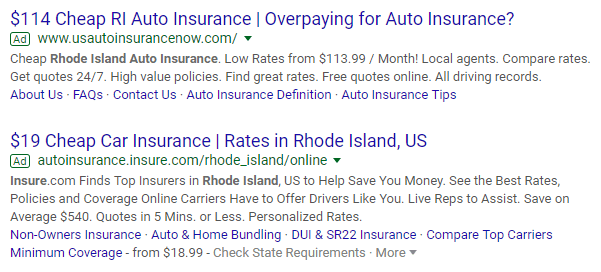
Look at the car insurance ads for Rhode Island. Neither of those brands has the household recognition of Progressive or State Farm, yet they immediately stand out because they lead with real figures. Actual prices. Real percentages. Clear savings. That kind of detail does the heavy lifting for you. The user doesn’t have to guess, interpret, or click just to find out if it’s worth their time—the ad already answers the most important question: Is this in my price range?
That’s a core principle in how to create ad copy that performs well. Make life easier for the user. Cut the fluff. Get to the point fast.
However, this tactic needs a bit of finesse. Numbers can work wonders—but only if they make sense in context. Take the custom T-shirt printing example. On paper, leading with a super-low price sounds smart. Who wouldn’t be interested in shirts for under $2? But here’s the problem: that number raises doubts instead of confidence. Before the user even clicks, they’re already wondering about quality, durability, and whether there’s a catch. Instead of curiosity, the ad triggers skepticism.
That’s the danger of using numbers carelessly. If your statistic creates more questions than answers, it can hurt performance rather than help it. Your goal is to build trust and clarity, not plant seeds of doubt.
Most people already have a rough budget in mind before they search. They know what feels “cheap,” “reasonable,” or “too good to be true.” By including realistic, credible numbers in your headlines or descriptions, you help prospects quickly compare your ad with competing ads and decide whether it’s worth clicking.
Used the right way, numbers don’t just attract attention—they qualify your traffic. And that means fewer wasted clicks and more conversions from people who are already comfortable with what you’re offering.
#3. Tap Into the User’s Sense of Entitlement (Carefully)
This one might sound a little uncomfortable at first, but let’s be honest—it works. Appealing to a user’s sense of entitlement isn’t about being manipulative for the sake of it; it’s about recognizing how people naturally think when they’re stressed, frustrated, or emotionally invested. And in many markets, that mindset is already there before the search even happens.
If you’re serious about learning how to create ad copy that connects on a deeper level, you need to understand this psychological trigger.
We live in a world where many people feel they deserve better outcomes, better service, better treatment, and better results. Whether that’s fair or not is beside the point. From an advertising perspective, this belief creates a powerful emotional hook—especially in high-stakes situations like legal disputes, financial loss, health issues, or major life changes.

The legal ad example nails this perfectly. A headline like “To Protect Your Best Interests” doesn’t talk about credentials, years of experience, or office locations. Instead, it speaks directly to what the prospect feels in that moment: I deserve to be protected. I deserve a fair outcome. Someone should be on my side. That single phrase instantly validates the user’s emotions and positions the advertiser as an advocate rather than just a service provider.
This is a strong lesson in how to create ad copy that persuades without overexplaining. When emotions are running high—like during a divorce or personal injury case—people aren’t looking for neutral information. They’re looking for reassurance, validation, and someone who will fight for what they believe they’re owed.
That’s why this approach is so common in the legal industry. Many people who file lawsuits already feel wronged. They believe something was taken from them—time, money, health, dignity—and they want it restored. Smart advertisers lean into that belief by framing their message around rights, protection, and personal interest. It’s provocative, yes, but also incredibly effective.
The key here is balance. You’re not promising the impossible or encouraging unrealistic expectations. You’re simply acknowledging the user’s emotional state and aligning your message with it. When done right, appealing to entitlement doesn’t feel aggressive—it feels supportive. And that emotional alignment can be the difference between an ignored ad and a clicked one.
Used thoughtfully, this technique can trigger strong engagement and make your ad feel deeply relevant in moments that matter most.
#4. Use Emotional Triggers to Make People Feel Something
If you want to understand how to create ad copy that actually gets clicks, here’s one rule you can’t ignore: emotion beats logic online—almost every time. People don’t scroll, search, or click in a calm, perfectly rational state. They click because something makes them feel curious, worried, excited, validated, or understood.
This is the same psychological fuel behind clickbait. You see a headline, feel a sudden emotional jolt—shock, fear, excitement, outrage—and before you even think it through, you’re clicking. That same principle applies to PPC ads, and when used correctly, it’s one of the most powerful tools in your copywriting arsenal.
When learning how to create ad copy, emotional triggers are what turn passive readers into active clickers.
Now, the type of emotion you tap into depends entirely on what you’re selling and what action you want the user to take. Negative emotions like fear, anger, suspicion, or anxiety can be incredibly effective—especially when the user is already emotionally vulnerable. But they require finesse. Push too hard, and the negativity can spill over onto how people perceive your brand.
Take the example of the service that helps people check whether their husbands are cheating. That’s an emotionally charged situation by default. The ad doesn’t scream accusations or shame the user. Instead, it subtly stirs curiosity and concern by highlighting how much information can be uncovered just by entering a name—dating profiles, criminal records, social activity. It quietly plants the thought: What if there’s something you don’t know? That subtle emotional nudge is far more effective than outright panic-inducing language.
This is a great lesson in how to create ad copy that leverages emotion without being aggressive. The ad doesn’t insult, threaten, or overwhelm—it simply opens a door the user already suspects exists.
On the flip side, positive emotional triggers can work just as well. Emotions like hope, reassurance, confidence, humor, and aspiration can be incredibly persuasive—especially in sensitive categories like health, fitness, or self-image. These are trickier to pull off because emotions like humor and affirmation are subjective. What one person finds uplifting, another might ignore entirely.
The aspirational body-image ad is a perfect example of this balance done right. Instead of leaning into shame or insecurity (which would be easy but risky), the advertiser uses encouraging language to inspire action. The emotional response is still there—it just feels empowering rather than confrontational. And that can make users feel safer clicking.
The key takeaway? Emotional triggers don’t have to be loud or dramatic. In many cases, subtlety wins. A carefully chosen phrase, a well-framed benefit, or a gently provocative question can trigger just enough emotion to earn the click—without damaging trust or brand perception.
When emotion and relevance align, your ad stops feeling like an ad and starts feeling personal. And that’s where the real PPC magic happens.
#5. Create Unique, Keyword-Rich Display URLs That Reinforce Your Message
Display URLs are one of the most underrated parts of a PPC ad. A lot of advertisers treat them like an afterthought—something to quickly fill in just to get the ad approved. And many beginners don’t even realize there’s a difference between the display URL (what users see in the ad) and the destination URL (where the click actually takes them).
But if you’re serious about learning how to create ad copy that performs, your display URL deserves just as much attention as your headline and description.
The display URL serves two important purposes. First, it gives users a visual cue about where they’ll land after clicking. Second—and this is huge—it’s another opportunity to reinforce relevance by including your primary keywords. Even if your actual landing page URL doesn’t contain the keyword you’re bidding on, you can still reflect that keyword in your display URL and improve how closely your ad matches the user’s search.

Take the security camera example. Instead of showing a generic homepage URL, the advertiser uses a display URL that clearly suggests a dedicated product page for security cameras. That instantly feels more relevant, more intentional, and more trustworthy. From the user’s perspective, it looks like, “Yes, this page is exactly what I’m searching for.” And relevance is everything in PPC.
This is an often-missed lesson in how to create ad copy that stands out. Your display URL doesn’t need to be flashy—it needs to be clear, specific, and aligned with your message. A well-structured display URL can subtly boost click-through rates by confirming to the user that they’re in the right place.
Think of it as visual reassurance. When someone is scanning multiple ads that all look similar, a keyword-rich display URL can be the small detail that tips the decision in your favor. It reinforces your headline, supports your value proposition, and strengthens your overall ad relevance in the search results.
Before you hit publish on any campaign, take a moment to review your display URLs. Ask yourself: Does this clearly reflect what the ad is offering? Does it include the keyword the user just searched for? Does it look more useful than a generic homepage link? If the answer is yes, you’re already a step ahead of most advertisers.
#6. Lead With Your Strongest Copy (Because Not Everyone Sees Everything)
When Google expanded text ads and gave advertisers more space—extra headlines and longer descriptions—it felt like a win for everyone. More characters meant more room to explain offers, highlight benefits, and persuade users. Google even reported that these expanded ads drove about 15% more clicks, which sounds like a no-brainer.
But here’s the catch—and it’s an important one if you’re learning how to create ad copy that performs consistently.
Not every user sees your full ad.
On smaller devices like smartphones and mini tablets, screen space is limited. That means Google often won’t show your third headline or second description line. So if you’ve saved your strongest message for the bottom of the ad, a huge chunk of your audience may never see it.
That’s why prioritization is critical when figuring out how to create ad copy for modern PPC campaigns.
The smartest approach is to frontload your best copy. Put your most compelling benefit, strongest value proposition, or clearest promise in Headline 1 and Headline 2, followed by the most persuasive part of your description in the first description line. These are the elements most likely to appear across all devices, whether someone is searching on a desktop monitor or a phone screen.

The KAYAK example shows this done right. On desktop, all three headlines appear, which is great for brand reinforcement. The third headline—usually the brand name or site URL—adds recognition, but it’s not essential for understanding the offer. The real selling power is packed into the first two headlines, which highlight the value and relevance of the service.
When you switch to mobile, those same key messages still appear. Nothing important is lost. The user still gets the core reason to click, even though the ad is shorter.
This is a subtle but powerful copywriting habit. Don’t assume users will see your entire ad. Write as if they’ll only see the first few lines—because many of them will. If the top of your ad doesn’t sell the click, the rest won’t matter.
Think of your ad like a news headline: lead with the strongest point first. Everything else is support. When you structure your ads this way, you protect your performance across devices and make sure your message lands no matter how or where people search.
#7. Address Objections Before Users Even Think to Ask
In most competitive PPC markets, users are running the same mental checklist before they click an ad. It usually boils down to just two questions: How much is this going to cost me? and How stressful or complicated is this going to be? If your ad doesn’t answer those questions, the user will keep scrolling until they find one that does.
This is a crucial concept to understand when learning how to create ad copy that converts—not just attracts clicks.
Instead of waiting for prospects to land on your site and raise objections there, smart advertisers deal with those objections directly in the ad itself. A little foresight and some well-placed copy can eliminate doubt before it has a chance to grow.

Look at the EverQuote ad for the search query “affordable home insurance.” This is a brutally competitive space dominated by huge, well-known brands. Standing out isn’t easy. But EverQuote does something smart right away: it leads with a clear price—$97—right in the headline. That single number immediately tackles the biggest fear insurance shoppers have: getting overcharged.
This is a textbook example of how to create ad copy that removes friction. By surfacing price early, the ad reassures the user that this option is at least worth considering. It doesn’t feel vague or evasive. It feels upfront. And that transparency builds trust before the click even happens.
The same principle applies to the second major objection: hassle. Users don’t want long forms, confusing steps, or endless back-and-forth. Ads that promise simplicity—“Get a quote in minutes,” “No paperwork,” “Compare instantly”—are quietly doing objection-handling work. They’re saying, This won’t be a headache.
You don’t have to address every possible concern in one ad. Just focus on the objections that matter most in your industry. If price is the main barrier, surface it. If time or complexity is the issue, emphasize speed and ease. When your ad answers the user’s biggest worries before they even click, you make the decision feel safer and easier.
The result? Better-qualified clicks, higher conversion rates, and fewer users bouncing because reality didn’t match expectations.
#8. Lead With Benefits, Not Bragging
By now, this idea should be familiar: people are naturally self-focused. And that mindset really shows when they’re scanning ads. When someone reads your PPC copy, they’re not asking, “Is this company impressive?” They’re asking, “What’s in this for me?” If your ad doesn’t answer that quickly, it gets ignored.
This is a core principle in how to create ad copy that actually converts.
A common mistake advertisers make is talking too much about themselves—how long they’ve been in business, how great their service is, how many awards they’ve won. None of that matters until the user understands how their own life improves by choosing you. Benefits always beat features, and features always beat fluff.
The insurance examples show this contrast clearly. The stronger ad focuses almost entirely on what the customer gets. It explains that the plan works with any licensed veterinarian, covers hereditary conditions, and protects pets regardless of age. These aren’t just facts—they directly solve real concerns pet owners have. Will I be locked into one vet? What if my pet has genetic issues? What happens as they get older? The ad answers all of these without ever talking about the company itself.
That’s exactly how to create ad copy that feels relevant and reassuring.
The weaker example, on the other hand, leans too heavily on vague claims or brand-centric language. It may technically describe the product, but it doesn’t clearly explain why the user should care. There’s no emotional payoff, no clear life-improvement moment for the reader.
This matters even more in hyper-competitive industries like insurance, where CPCs are high and users compare multiple ads side by side. When every company is offering “great coverage” and “trusted service,” benefits are what separate the winners from the rest. The ad that clearly says how your life gets easier, safer, or cheaper is the one that earns the click.
When writing your body copy, constantly translate features into outcomes. Don’t say what your product does—say what problem it removes. Don’t say what you offer—say what the user gains. If every line of your ad answers the question “How does this help me?” you’re on the right track.
Conclusion
At the end of the day, writing effective PPC ads isn’t about clever wordplay or stuffing in every feature your product has. It’s about understanding people—how they think, what they want, and what makes them click. Once you truly grasp how to create ad copy, everything else in your PPC strategy starts falling into place.
Great ad copy starts by mirroring the user’s objective. When your ad reflects exactly what someone is trying to achieve, it feels instantly relevant. From there, using numbers or statistics in your headlines helps cut through the noise and give users something concrete to latch onto. Specifics build trust faster than vague promises ever could.
Appealing to a user’s sense of entitlement—when done carefully—can also be incredibly persuasive, especially in emotionally charged or high-stakes industries. Pair that with well-placed emotional triggers, and your ads stop feeling generic and start feeling personal. Whether it’s reassurance, curiosity, fear, or aspiration, emotion is often the final push that turns a glance into a click.
The details matter too. Keyword-rich display URLs reinforce relevance and reassure users they’re clicking through to exactly what they searched for. Prioritizing your best copy ensures your strongest message shows up across all devices, especially on mobile where space is limited. And by preemptively addressing common objections like price and effort, you remove hesitation before it even has a chance to form.
Finally, always focus on benefits, not bragging. Users don’t care how amazing your company thinks it is—they care about how their life gets easier, cheaper, or better by choosing you. When your ads speak directly to that, performance follows.
If there’s one takeaway from this entire guide, it’s this: learning how to create ad copy is less about writing and more about thinking. Think like your audience. Speak to their goals. Anticipate their doubts. Trigger the right emotions. Do that consistently, and your PPC ads won’t just get clicks—they’ll get results.