Writing Google Ads copy that actually converts is a careful mix of creativity and logic. You’re working with tight character limits on SERPs, so every single word has to earn its place. No fluff, no wasted space just clear, persuasive messaging that pulls people in. In this guide, we’ll break down how to strike that balance and write high-converting ad copy that delivers real PPC results.
The truth is, crafting strong Google Ads for PPC isn’t complicated but doing it well takes intention. You need to think beyond the ad itself and focus on the full journey: the search query, the ad copy, and the landing page it leads to. When everything lines up, clicks feel natural. When it doesn’t, users bounce fast and probably click on a competitor who got it right.
That’s why learning how to write high-converting ad copy means understanding user intent, setting the right expectations, and guiding people smoothly from search to solution. And remember, even the best ad won’t save a weak landing page both have to work together to close the deal.
Feeling stuck on where to begin? Don’t stress. Once you understand the basics of Google Ads and how campaigns are structured, writing effective copy becomes a whole lot easier and far more profitable.
What Is Google Ads Copy?

Google Ads is Google’s online advertising platform—the one behind those ads you see at the top of search results, inside Google Maps, and sprinkled across websites through display ads. It runs on a pay-per-click (PPC) model, which simply means you only pay when someone actually clicks your ad.
One of the biggest perks of Google Ads is reach. Google controls over 90% of the search market, so when you advertise there, you’re putting your message in front of a massive audience that’s already looking for something. On top of that, Google lets you get really specific with targeting. You can show ads based on age, gender, search behavior, location, and even past interactions with your brand.
But here’s the catch, visibility alone won’t cut it. Just because your ad shows up doesn’t mean people will click. That’s where strong Google Ads copy comes in. To write high-converting ad copy, you need messaging that grabs attention fast, speaks directly to intent, and makes clicking feel like the obvious next step.
In short, Google Ads copy is the bridge between a search and a solution. And if you want results—not just impressions—you’ve got to write high-converting ad copy that turns curiosity into action.
6 Strategies To Write Google Ads Copy

#1. Match Your Ad Copy with User Intent
This sounds obvious, but it’s where a lot of Google Ads go wrong. People don’t open Google to kill time—they’re there with a mission. They’re searching because they want an answer, a fix, or a solution right now. And if your ad copy doesn’t line up with that intent, it gets ignored.
Unlike social media, where users are just scrolling for vibes, search ads are driven by intent. Someone typing a query into Google already knows what they’re looking for—they just need help choosing who to get it from. That’s why learning how to write high-converting ad copy starts with understanding why the user searched in the first place.
Search intent generally falls into a few buckets: informational (they want to learn), commercial (they’re comparing options), navigational (they’re looking for a specific brand), or transactional (they’re ready to buy). Your ad copy should mirror that intent. A “ready-to-buy” search deserves a direct, confident offer—not a vague explainer.
When you write high-converting ad copy that speaks directly to what the user wants, two good things happen. First, more people click because the ad feels relevant. Second, Google rewards that relevance with a better Quality Score—which often means lower costs and better ad positions. In other words, matching user intent isn’t just good copywriting… it’s smart advertising.
#2. Focus on Benefits, Not Features
This is one of those marketing rules everyone has heard… yet somehow forgets the moment they start writing ad copy. Here’s the simple truth: features explain what a product has, but benefits explain why anyone should care. And when you want to write high-converting ad copy, “why it matters” always beats “what it does.”
Think of it this way—features speak to logic, benefits speak to emotion. A feature might say what your product offers, but the benefit shows the outcome your customer actually gets. People don’t buy tools; they buy results. They don’t buy faster software—they buy saved time, less stress, and better outcomes.
There’s a reason great marketers flip the question from “What does this product do?” to “What does this product do for the customer?” That shift is where strong ad copy starts to convert. When you write high-converting ad copy, you’re tapping into emotions that influence buying decisions—things like fear of missing out, desire for status, pride in making a smart choice, or relief from a frustrating problem.
That doesn’t mean you manipulate or overdo it. It means you frame your message around the real-life win your customer is looking for. Lead with the payoff, not the technical details. You can always support the benefit with features later—but if the benefit doesn’t hook them first, they won’t stick around long enough to care.
#3. Use Numbers, Statistics, and Data to Build Instant Trust
If you want to write high-converting ad copy, numbers are your quiet secret weapon. They add clarity, credibility, and a sense of “this is real” to your message—fast. When people see concrete data, they don’t have to guess. They can quickly decide if your offer fits their needs.
Now, this doesn’t mean throwing around empty claims like “#1 in the world” with no proof. Savvy users can smell that from a mile away. Instead, focus on practical, decision-making details—price points, delivery timelines, turnaround speed, or effort required. These are the things that reduce friction and make clicking feel safe.
For example, saying “Plans start at ₦15,000/month,” “Delivered in 48 hours,” or “Set up in under 5 minutes” instantly answers questions your prospect is already asking in their head. That’s how you write high-converting ad copy—by removing doubt before it shows up.
Numbers also make your ads scannable. In a crowded SERP, data jumps out visually and grabs attention faster than vague promises. When done right, statistics don’t just decorate your ad—they guide the decision. And when people feel informed, they’re far more likely to click.
#4. Personalize Your Ad Copy to Speak Directly to Your Audience
A key way to write high-converting ad Copy is to make each person feel like you’re talking directly to them. Even if your ad reaches thousands of people, the magic happens when your message feels personal—when it says “you,” not “we.”
We might wish Google could insert first names, but until that day comes, the best trick is to shift the focus from your company to the customer. Instead of telling people what you do, show them how your product or service helps them achieve their goals.
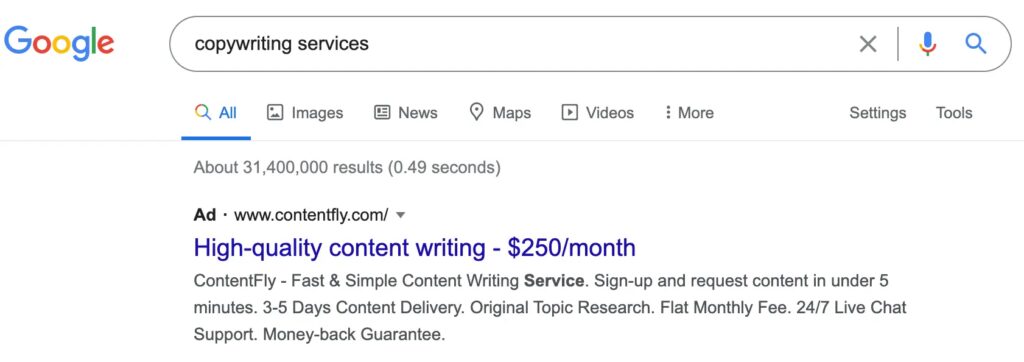
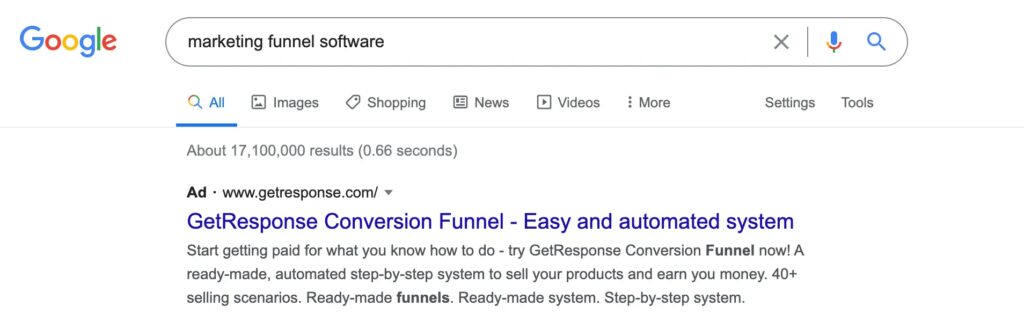
GetResponse nails this for the search term “marketing funnel software.” Their ad copy speaks to the user’s needs: “get paid for what you know” and “sell your products and earn money.” It’s subtle but powerful. That’s exactly how you write high-converting ad Copy—by putting the customer in the spotlight and making them the hero.
Remember: the more your audience sees themselves in your words, the more likely they are to click, engage, and convert.
#5. Boost Visibility with Keyword-Rich Ad Extensions

One smart way to write high-converting ad Copy is by taking full advantage of ad extensions. These let you add extra info that helps prospects make decisions, while also giving your ad more space on Google—making it pop compared to competitors.
Google itself recommends using all relevant extensions because it selects which ones to show based on each search. That means the more targeted your extensions are, the better your chances of catching the right eyes.
Ad extensions are also perfect for slipping in a clear call-to-action (CTA). A simple line telling the searcher exactly what to do next—like “Get started today” or “See pricing now”—can make a big difference.
So if you want to stand out and drive clicks, think beyond your headline. Using keyword-rich ad extensions is a must when you’re looking to write high-converting ad Copy that doesn’t just exist, but actually converts.
#6. Test, Iterate, and Optimize to Write High-Converting Ad Copy
One thing to remember when you want to write high-converting ad Copy is that it’s never “set and forget.” Like any marketing effort, your PPC ads need constant testing, tweaking, and optimization. The small details can make or break your campaign, so obsessing over what resonates with your audience pays off big time.
Unbounce suggests experimenting with different angles in your ad copy, such as:
#1. Features vs. benefits
#2. Problems vs. solutions
#3. Testimonials and reviews
The easiest way to do this in Google Ads is to launch multiple variations of the same ad in each ad group. Track which version performs best, then refine and iterate. Over time, this process helps you consistently write high-converting ad Copy that actually drives clicks, leads, and sales—turning your ads from “just there” into profit-generating machines.
Conclusion
Writing Google Ads copy isn’t a one-and-done deal—it’s an ongoing process of testing, learning, and tweaking. At its core, your PPC ads are talking to real people, so ditch the jargon and focus on addressing their questions, pain points, and desires. That’s how you grab attention and get clicks.
Since optimizing your copy is constant, tracking your results is crucial. A dedicated Google Ads reporting dashboard makes this easy, letting you see which campaigns are performing, which ads need work, and which messages resonate most. You can monitor key metrics like clicks, conversion rates, and quality scores, all of which reveal how effective your copy really is.
By consistently analyzing results and refining your approach, you’ll be able to write high-converting ad Copy that speaks directly to your audience and drives real results. With practice, testing, and data on your side, you’ll consistently write high-converting ad Copy that turns clicks into customers.